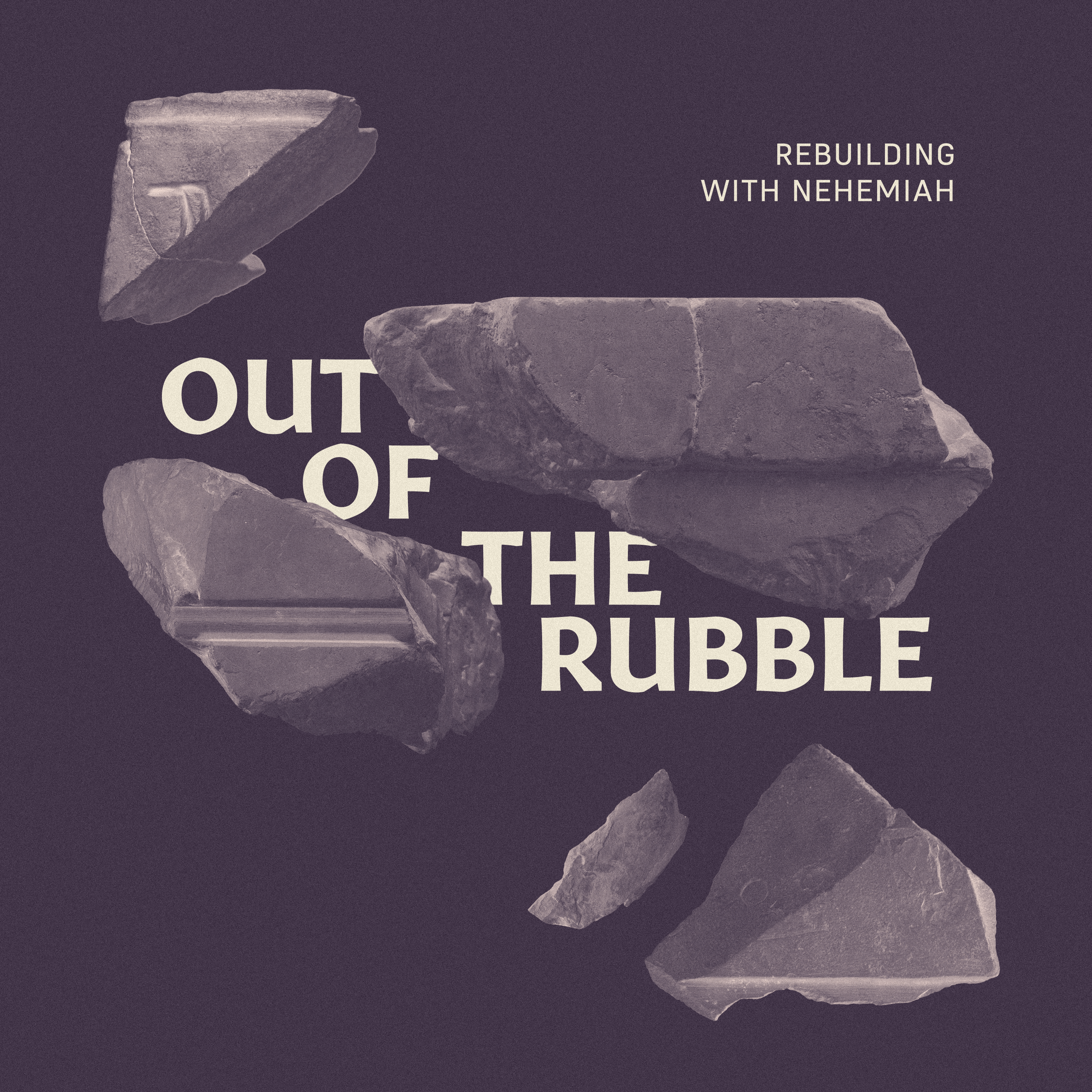
Out of the Rubble
The walls of Jerusalem lay in ruins for 140 years. Then one ordinary person decided to stop waiting for someone else to go first. In fifty-two days, what five generations said couldn't be done — was done. Eight weeks from now, what might be different in you, and around you?
Throughout Nehemiah, rebuilding Jerusalem’s broken walls becomes a story of much more than repairing stone. It is a story of God renewing people and places as ordinary people pray, step forward, work together, face opposition, and keep going.
Over these eight weeks, we’ll use the language of repair for the places where God may be inviting us to participate in His work of renewal — in our relationships, neighbourhoods, workplaces, communities, and beyond.
An 8-Week Personal Journey
Week One - When Something Breaks Your Heart
OBSERVE
Reflect on this week's passage: Nehemiah 1
Nehemiah’s journey began when he heard that Jerusalem was still broken down and its people were living with shame and vulnerability. Before he made a plan, he allowed himself to see what was wrong — and to feel it.
Every repair project begins the same way: with a moment of seeing.
Not glancing. Not scrolling. Not noticing for half a second.
Seeing.
And then — feeling.
The 30-Minute Walk
Set aside 30 minutes this week for a slow, intentional walk through a place you frequent — your neighbourhood, workplace, school, or local shops. Leave your phone in your pocket. Walk slowly.
As you walk, take note of the people, the buildings, the activities, and the life experiences around you. Notice the signs of hope — and the signs of pain. Notice beauty. Notice strain. Notice what the Spirit nudges in you.
Write down what stands out.
Then sit with what you found.
Don't rush to fix it. Don't manage it. Don't scroll past it. Ask yourself: what have I been walking past without really seeing? What is God getting me to notice?
If you're already aware of a specific brokenness — relational strain, a struggling community, mental health challenges in people you love — sit with it rather than managing it. Allow yourself to feel the weight of it.
This is where every repair story begins. Not with a plan. With an ache.
Then — have a conversation with a local.
Venture out into your community and find someone to talk with — a café owner, a shopkeeper, a school teacher, a next-door neighbour. Tell them you have a heart for the neighbourhood. Ask them: what do you love about this place? What concerns you? What could be better? What could be renewed?
Listen carefully. Don't rush to fix — just listen.
Write down what moves you. Bring it to God.
Week Two - Before You Make a Move
PRAY
Reflect on this week's passage: Nehemiah 2:1–16
Before Nehemiah began rebuilding, he spent months praying. Nehemiah prayed for four months before he said a word to anyone. His prayer gives us a pattern to follow. This week, try moving through these five movements yourself.
Start with who God is — not a request, not a problem. Just who He is. Spend time here before you move on.
Move to what we've done — own your place in the story honestly. Don't rush past this.
Stand on what God has promised — find one verse and pray it back to Him. Let your hope be anchored to His word, not your feelings.
Ask for what you need — boldly, specifically. If there is a decision, conversation, deadline, or next step ahead, name it.
And then wait — keep the journal open through the week. Make space to listen for what God may be saying.
A burden without prayer becomes anxiety. A burden carried to God in prayer can begin to become calling.
Return to this prayer across the week. Nehemiah prayed for months. Start with four days.
Week Three - We're All In This Together
DREAM
Reflect on this week's passage: Nehemiah 2:17–3:32
Nehemiah eventually invited the people of Jerusalem into a shared vision: Come, let us rebuild. Then people from many different backgrounds took responsibility for different parts of the work.
Take a pencil, some crayons, and a blank piece of paper. Begin to write, to sketch, to list. Start to dream.
With what you've been observing and praying over — what could renewal look like for the people and places around you? Where might God be inviting you to participate?
Ask yourself: what will it look like? Where will it be? What do you need? When could it happen? Who might help? What might the results be?
And before you assume you need to start something new — ask: who is already doing something in this space? Is there existing work of renewal you could support, join, or strengthen rather than duplicate?
Don't edit too soon. Let yourself see the future before you start managing it.
Then begin to plan.
Vision without planning is just wishful thinking. Once a picture has formed, ask: what is one concrete first step? What resources would you need? What is a realistic timeframe?
Week Four - When They Want You To Stop
SHARE
Reflect on this week's passage: Nehemiah 4
As the rebuilding gathered momentum, so did opposition. Nehemiah and the people faced mockery, threats, and pressure to stop. They prayed, stayed alert, and kept building.
Go on — be brave. Share.
Find one person this week and share the dream and the emerging plan you've been carrying. A friend, a family member, someone you trust. Ask them:
- Is this a good idea?
- How might it be even better?
- What am I missing?
- Could you help me?
Listen carefully to their feedback. Don't defend — receive. The goal isn't to convince them. It's to sharpen and strengthen what you're carrying.
Then pray together. Ask God to provide the guidance, the courage, and the right people to see it through.
Opposition may also begin to feel more real once you move from thinking about something to actually acting on it. Discouragement, distraction, uncertainty, or criticism can all make it tempting to step away.
Later in the story, Nehemiah describes what he is doing as a “great work” and refuses to be distracted from it. Your “great work” is the particular piece of God’s renewing work you believe He is asking you to give yourself to in this season.
Try writing yours in one sentence and put it somewhere you'll see it.
I am carrying on a great work and cannot come down. — Nehemiah 6:3
Week Five - When It Gets Personal
MOBILISE
Reflect on this week's passage: Nehemiah 6
Nehemiah didn't rebuild Jerusalem alone. Throughout the story, people with different roles, skills, families, and backgrounds joined the work. In Nehemiah 3, many repaired the section of wall nearest to where they lived or worked.
Two questions for this week.
First: where is your section of the wall? In other words: what brokenness is already within your reach — in your neighbourhood, your workplace, your family, your community? You don't need to look far. Sometimes your proximity to a need is one of the clues to where God may be asking you to participate.
Second: who is your unlikely builder? Who is one person in your world who might say yes if you asked — perhaps someone from a different background, a different skill set, a different circle than you'd expect?
Identify them. Then have one conversation. Use the REACH framework to share the vision clearly:
- Reality — name the brokenness honestly. Help them feel the problem, not just understand it.
- Evidence — show where God is already at work. What has He already done? What doors have opened?
- Ask — invite them in. Not "I'm going to do this" but "Come, let us."
- Community — say us, not I. This is a shared mission, not a solo project.
- Hope — paint the picture of what could be. What might renewal look like, and why is it worth giving yourself to? Why is there worth the cost of leaving here?
People are often moved by more than need alone. They are moved by calling. Help them see how they could meaningfully contribute. Give them the dignity of being genuinely needed — not simply used.
Week Six - When Conflict Arises
PERSEVERE
Reflect on this week's passage: Nehemiah 5
Not all the problems Nehemiah faced came from outside Jerusalem. In Nehemiah 5, injustice and conflict appeared among the people themselves. Nehemiah had to address what was happening inside the community while the rebuilding continued.
Opposition comes in waves. This week, take stock of where you are.
External pressure — have the voices of mockery, criticism, or discouragement found their way into your insecurities? Write down what each voice says. Then ask: What is true? What does God say in response.
Not every criticism is wrong, so listen humbly for anything you need to receive. But don't allow fear, shame, or someone else's cynicism to determine your obedience to God. The voice that tries to shrink your calling is never the voice of God.
Internal conflict — is there something brewing inside your own community, team, or family that needs to be named? Some of the hardest challenges come from within. Ask honestly: where do I need to not just name the problem but model the alternative? Is there a conversation I've been avoiding? Take one step toward it this week.
Personal distraction — What invitations or demands are pulling you away from what you believe God has given you to do? Name them. Which are good things that aren't necessarily your things? Practise saying no to something good this week in order to protect something essential.
And through it all — keep building. In Nehemiah, the people remained ready to defend the work, but they never stopped doing the work itself. Keep your hand on the trowel.
Write your great work in one sentence if you haven't already. Read it back to yourself before you respond to the next invitation.
Week Seven - All Finished and Just Beginning
CELEBRATE
Reflect on this week's passage: Nehemiah 8–10
The wall was completed — but finishing the wall wasn't the end of God's work. The people gathered, listened again to God's word, worshipped, confessed, celebrated, and renewed their commitment to Him.
So this week: celebrate.
Name something God has done — in your life, your community, your church — that you've been rushing past. Tell someone about it. Thank God for it out loud, specifically.
Write a short note or message to someone who has been part of your repair story — someone who has prayed, encouraged, worked, listened, challenged, or helped.
Tell them what their faithfulness has meant. Tell them what you've seen God do through them.
Don't wait until everything is finished. Do it now.
Let the sound travel a little further than your own head.
The joy of the LORD is your strength. - Nehemiah 8:10
Week Eight - There's Always More to Do
REVIEW AND RETURN
Reflect on this week's passage: Nehemiah 11–13
The walls of Jerusalem were rebuilt. The celebration was over. The choirs had gone home.
And then Nehemiah came back — and found things had drifted.
He didn't despair. He began again.
This week isn't about finding another new project. It's about pausing long enough to see what God has done, noticing what may need attention again, and naming what comes next.
Take some time — a journal, a quiet morning, a conversation with someone who has been on this journey with you — and work through these questions.
Look back and name what's different:
- What did you notice in week one that you hadn't seen before?
- What burden has stayed with you?
- Where did you see God move — in you, or around you?
- What has changed in how you see the brokenness around you, and how you pray?
- What have you actually done that you might not have done eight weeks ago?
Look forward:
- What is your next step — one specific action in the repair work you've been called to? Who is building alongside you?
- What has drifted that needs to begin again?
- What needs to be removed from the centre to make room for what matters most?
Write it down. Share it with someone. And carry it forward.
This is the rhythm of repair: observe, pray, dream, share, mobilise, persevere, celebrate — and begin again.
It doesn't end. It multiplies.
As we say yes, may we know what Nehemiah knew: the gracious hand of our God is upon us.